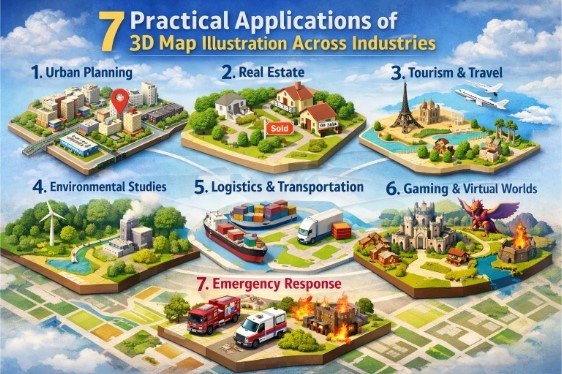
Many industries require a good understanding of space, scale, and connection, yet flat maps have always been a poor substitute. Although information may be relayed via flat maps, it does not explain anything.
As such, 3D map illustration became a wonderful tool in various sectors. With this tool, one can understand a complex location quickly and intuitively by introducing depth, perspective, and real-world context.
Many organizations now seek out the best-in-business 3D rendering company to convert raw geographical data into visuals that capitalize on communication.
Real Estate and Large-Scale Developments
It is said in real estate: everything is about location. And that can be a tricky thing to explain. 3D map illustration allows developers to demonstrate viewpoints of how the project fits within the surrounding area, including the nearest roads, landmarks, green space, and infrastructure.
Buyers and investors have an immediate perception of proximity and scale, thus eliminating any reliance on imagination. This clarity builds the trust factor of investors and shortens decision cycles, especially in the case of residential townships, commercial hubs, and mixed-use development arms.
Urban Planning and City Infrastructure
Planning cities should involve many layers of information, often overwhelming for the non-technical audience. Actual roads, utilities, zoning, public transport, and future expansions are best seen in three dimensions.
3D map illustrations help planners communicate their long-term vision in a clear form to public authorities, other stakeholders, and all citizens. When they can actually see how a city will work and evolve gradually over time, people begin to relate to their cities differently and feel part of a larger picture.
Tourism and Destination Promotion
Tourism relies on visual cues and clear information. For a traveller, these may be more about opportunities that lie in the vicinity and how they are related to one another. The 3D representation of the map essentially brings the destination to life, showing something of the lay of the land, the attractions, routes, and landmarks-all in one view.
Before any actual visitor arrives at the destination, these visuals usually appear on websites, brochures, and visitor information centers, thus making the visitors feel as though they have been invited to visit the place.
Transportation and Infrastructure Projects
Infrastructure itself is a complicated and high-budget affair; hence, anything has to be communicated well. 3D maps help explain highways, rail networks, airports, and metros through an understanding of how their workings interact with those of existing environments.
This way, stakeholders can better visualize access points and their surrounding or impact zones. This reduces misunderstandings, supports approvals, and ultimately aligns the engineers, authorities, and general communities in a common way of understanding.
Logistics and Supply Chain Planning
In logistics, the most efficiency will depend on how well you understand the spatial relationships. Warehouses, delivery routes, distribution centres, and service zones are simply much easier to analyse in a 3D environment.
Using 3D map illustration allows companies to discover inefficiencies and to formulate accurate plan layouts and expansion options. The creation of a visual dimension to the entire network allows for collaboration at a robust level, where it gives planning an increased data-driven approach as opposed to speculative planning.
Environmental and Sustainability Initiatives
Environmental projects deal with sensitive landscapes and long-term consequences. In this regard, a 3D map illustration brings together terrain, vegetation, water systems, and human activities in one view.
It depicts the extent to which a project interacts with its natural surroundings and informs what is undertaken in terms of protecting the ecosystems. Keeping the visual clear helps create the necessary transparency and trust between regulators, communities, and funding partners on sustainability initiatives.
Education and Public Awareness Projects
Geography, urban growth, or historical development becomes difficult to explain employing written words alone. This is where educational institutions and public organisations turn to 3D map illustration for fun and intuitive learning.
In whatever respect, whether through illustrating how a city evolved, how a region is structured, or how a new project is set to change an area, visual storytelling will facilitate memorization and understanding.
Why 3D Map Illustration Works So Well
Across all these industries, clarity matters, and clarity makes profits for 3D maps. The relationship distance and scale are all represented visually, which clears away almost all interpretation errors. The 3D maps save time, reduce confusion, and enable better decisions.
Such illustrations, when created by any best 3D rendering company, combine technical competencies with storytelling techniques that make them useful for expert teams as much as for the general audience.
Conclusion
With the increasing size and complexity of projects, the need for spatial communication continues to grow. 3D map illustration meets this need by converting location-based data into visuals that people can easily relate to.
Its applications are practical, infinitely flexible, and powerful, cutting across real estate, infrastructure, tourism, and education. Applied wisely, it holds promise as more than a design asset.
Rather, in this role, it becomes a communication tool that propels industries to plan better, explain faster, and move with confidence.