Table of Contents
- The Rise of Self-Service Kiosks
- Enhancing Travel Experiences
- Technological Advancements in Kiosk Solutions
- Case Studies: Real-World Implementations
- Future Trends in Transportation and Tourism Kiosks
- Conclusion
In today’s fast-paced world, the transportation and tourism industries are undergoing profound digital transformation, prioritizing enhanced customer experiences and streamlined operations. Central to this evolution is the integration of self-service kiosks, which have dramatically shifted the way travelers interact with essential services. With solutions like KIOSK travel solutions now available, both industries are leveraging technology to deliver quick, user-friendly, and efficient service options at the touch of a screen.
Modern travelers expect convenience, accessibility, and immediate information during their journeys. Digital kiosks not only empower users to take control of their travel needs but also support service providers with valuable data and 24/7 coverage. As the adoption of these self-service platforms grows, the ability for airports, train stations, and tourist attractions to meet rising demand and new digital expectations increases substantially.
Industry leaders are recognizing that a successful travel experience goes beyond just moving people from one location to another. It extends into offering seamless, multilingual information, robust support for international travelers, and a consistent service experience across time zones. Kiosks fill this critical gap with accessible interfaces that reduce friction for both seasoned globetrotters and first-time travelers alike.
Furthermore, enhanced digital experiences enabled by kiosks help operators manage their resources more effectively and gather actionable insights that will shape future customer service strategies. This widespread impact reveals why self-service solutions are at the forefront of transforming the way people travel and explore.
The Rise of Self-Service Kiosks
Self-service kiosks have become a staple across airports, rail stations, rental car hubs, and major attractions. Their rapid adoption is fueled by travelers’ expectations for faster services and by organizations seeking to reduce operational bottlenecks. Instead of waiting in long lines for check-ins or ticketing, customers can now access services independently, anytime. The presence of kiosks means that transportation and tourism providers can deliver uninterrupted support, handle peak crowds efficiently, and adapt quickly to changing travel dynamics.
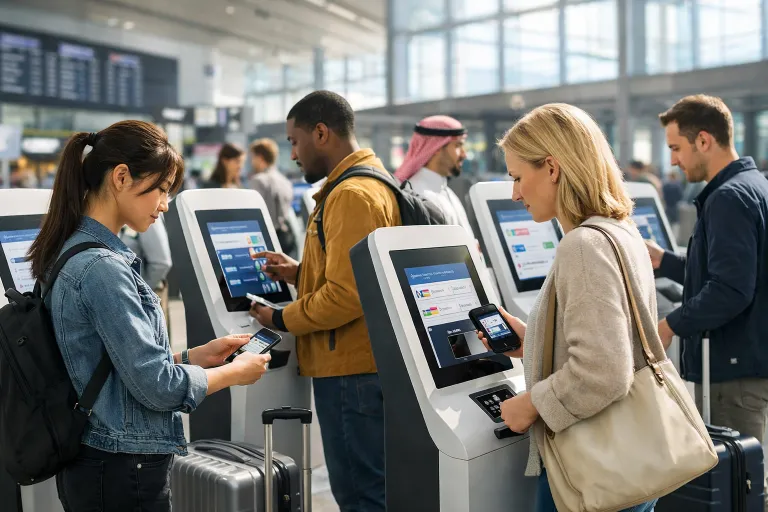
Airports around the world are making multi-million dollar investments into digital upgrades, and kiosks play a central role in these improvements. For travelers, the ubiquity of self-service technology means more freedom, speed, and certainty in their travel routines.
Enhancing Travel Experiences
Integrating self-service kiosks delivers direct benefits to travelers as well as to service operators. Among the top enhancements are:
- Reduced Wait Times: Kiosks enable multiple customers to serve themselves simultaneously, which reduces queue sizes and frees staff to assist with complex inquiries.
- Multilingual Support: By offering content in a range of languages, kiosks cater effectively to global audiences and remove language barriers that can hinder a smooth trip.
- 24/7 Availability: Travel does not stop at night or on weekends, and kiosks function around the clock to provide immediate access to information, bookings, and support whenever needed.
Improved experiences also translate into better online reviews and increased customer satisfaction, which are essential in today’s highly competitive market. In destinations that serve as major international gateways, kiosks help reassure visitors with consistent and accessible service, contributing to local tourism growth.
Technological Advancements in Kiosk Solutions
The capabilities of kiosk technology have advanced significantly, making them even more effective in fast-moving travel environments. For example, Palmer Digital Group recently unveiled battery-powered kiosks for indoor and outdoor use. These models offer robust battery life, eco-friendly materials, and integrated wireless sensors that track customer movement, enabling businesses to optimize engagement and operations. Read more about their innovative solutions at AV Network.
Sophisticated kiosks now feature touch-free interfaces, facial recognition, and real-time integrations with backend systems, further shortening the service delivery time. As the Internet of Things (IoT) connects more platforms, kiosks can sync with digital signage, mobile devices, and customer loyalty programs for a truly seamless experience.
Case Studies: Real-World Implementations
Practical examples showcase how kiosks are changing travel and tourism for the better:
- Uber’s Airport Kiosks: At New York’s LaGuardia Airport, Uber launched kiosks to facilitate ride booking for travelers without smartphones or data plans, broadening accessibility and expediting ground transportation.
- Jacksonville’s Autonomous Transit Program: The Jacksonville Transportation Authority rolled out digital kiosks to support its downtown autonomous vehicle fleet, enhancing passenger experience and assisting with the adoption of cutting-edge transit options.
Future Trends in Transportation and Tourism Kiosks
The landscape of transportation and tourism kiosks continues to evolve. In the coming years, the market is expected to see:
- Deeper Integration with Mobile Devices: Customers will enjoy even smoother experiences as kiosks synchronize with personal devices, enabling mobile check-ins, contactless payments, and personalized travel recommendations.
- Artificial Intelligence: AI-driven kiosks will provide intelligent, dynamic assistance and anticipate user needs through predictive analytics, elevating the support level for travelers.
- Enhanced Accessibility: New designs will incorporate features for people with visual, auditory, and physical disabilities, making travel more inclusive for everyone.
Conclusion
The ongoing digitization of transportation and tourism is fundamentally reshaping how people travel and explore new destinations. Self-service kiosks stand at the center of this transformation. They deliver efficient, user-friendly, and highly accessible services for travelers, while boosting operational efficiencies for service providers. As technology continues to advance, these kiosks will grow in capability and importance, unlocking new opportunities for seamless, enjoyable, and inclusive travel experiences worldwide.