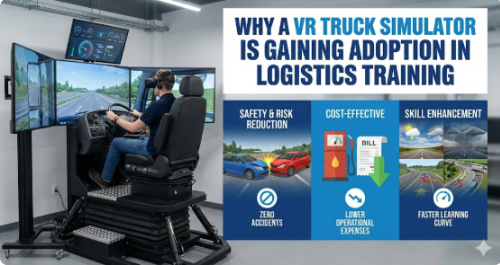
The freight and logistics industry is undergoing rapid change as new digital innovations, safety regulations, and productivity standards inevitably alter the ways in which companies pursue transportation solutions.
Working towards an optimised global supply chain, logistics companies are more pressured than ever before with customer requests for faster delivery windows. Logistics businesses are beginning to find it more difficult to train effective drivers while minimising the risk.
On the road, training is no longer viable in the modern operation. Innovative training methodologies and tools, including the development of a VR truck simulator, are providing the ability to create virtual, real-world driving environments that better prepare logistics operators to efficiently deliver goods without placing existing resources at risk and without the theory deviating too far from real conditions.
The Modern Logistics Driver
Modern delivery vehicles are more complex to operate than in the past. Large vehicles must be manoeuvred skillfully through often chaotic cities, adhere to strict traffic regulations, while also coping with constantly changing weather and roadway conditions. However, simulating conditions and conducting tests with equipment, trucks, and people is difficult when relying only on generic classroom sessions.
Testing a truck and how it behaves in real-world driving on the road can cost a substantial amount of capital in high fuel consumption, more often than not result in damage to tyres, and have safety implications.
Online driver training courses, safety training communication materials, and logistical obstacles like high-skilled driver shortages and the ever-increasing number of compliance regulations all require more cost-effective, scalable, and replicable training delivery arrangements. Existing simulation advances allow learning companies to tailor how training exercises will be executed to an optimal delivery modality.
An effective approach to developing truck driving skills in a virtual environment.
Virtual reality training offers a unique level of immersion and user engagement that they cannot achieve. Unlike the traditional modes of viewing videos or using static, non-interactive interfaces, those participating in a VR training module are immersed in a driving simulation, contributing to their interactions by having to make split-second decisions in response to hazards of traffic, road environments, other vehicles, and people.
Drivers can develop their skills, and refresh each of the following situations with the ultimate goal of obtaining each person and load.
- Garage and open road navigation
- Parking in tight places, such as docks
- Night driving and difficult weather conditions
- Emergency action with load stability objects
- Managing driver and order fatigue levels
While this complex process will do wonders for muscle memory and quick, accurate decision-making skills, this process of learning has its own advantages in terms of the dimensional transfer of situations for driver awareness.
Cost Benefits And Efficiency For Logistics Driver Education Through VR Training
Cost reduction in driver education is obviously the most prominent benefit of using virtual reality systems. The use of actual trucks for training inevitably involves fluctuating costs derived from expenses, including evaluation acceleration, instructors, maintenance, and insurance rates. Although training manoeuvres could be planned to prevent incidents or hits and crashes, a potential accident may be prohibitively costly.
A logistics truck VR trainer may enable a company to:
- Bring multiple students together in one sitting to learn.
- Ensure consistent courseware throughout all of a corporation‘s locations.
- Remove the high operating costs of rising fuel use, vehicle upgrades, and repairs.
- Drop readiness time without decreasing quality.
Ultimately, the cost savings will begin to overshadow the cost of investing in the VR hardware.
Standardised And Measurable Training Results
Traditional types of driver training may not provide the metric consistency that will influence the fair evaluation of trainees, but the virtual layer will effectively place the same parameters on all drivers. When using these portable visual environments, tracking becomes much more detailed by monitoring:
- Each person‘s reaction time
- How well the trainee follows the rules
- How do they make decisions?
Emergency activities while driving. Driving efficiency with search and drop systems.
This information can be used for more detailed capabilities testing and trend analysis to a degree that traditional certifications cannot match. Establishing a scalable framework for driver expertise development will afford clearer certification benchmarks.
Compression Of Training Schedules And The Deficiency Of Driving Staff
The chronic driver deficiency seen throughout the industry and the work segmentation can be alleviated by even more productive training. Skills ramp-up can be accelerated across aspirant team members and business development, with the driver route presence, which can be more efficient while providing the autonomy of a supporting staff.
By enlisting a 3D visualization company, logistics and distribution companies may be able to embed a specific type of vehicle, hardware configuration, and operation room practice into the virtual environment to speed the integration process.
Simulating Every Emergency
One other use case which VR technology can provide would be high training scenarios which could prove much too risky in the real delivery world; approaching guys lost in the road, poorly ploughed roads, tyre blowouts, reckless pedestrians, and more.
Deliveries that utilise VR-focused training on tyre defects, dangerous weather, and traffic patterns will push prepared drivers to the limits, therefore stacking their own expectations of success before they really are, thus better able to excel on real routes.
Fostering Sustainability In Logistics With VR
Immersive VR delivery systems, which reduce the amount of commute hours for employees, will advance a company‘s ecologically inspired targets while reducing delivery atmosphere emissions. Logistics transportation sustainability objectives also complement VR‘s potential for using zero emissions rubber.
Integrating Other Logistics Or Training Data
The details of a virtual trainer can be integrated with existing enterprise resource planning, vehicle telemetrics, or perhaps individual employee training protocols, and allow your data to be stored for future analysis and performance centralisation.
The Strength Of 3D Graphics
Much like the unique qualities of a drone are heavily weighted by the quality of the lens the engine holds, the credibility of the imagery on a VR truck simulator is based on the quality of the 3D content. Since accurate depiction of road surface variances, vehicle behaviour, shock transmission, and lighting effects will be as critical as realistic simulation conditions, forging a partnership with a professional 3D avatar service firm is essential.
Conclusion
As business becomes more exacting in its range of delivery experiences and its expectations of safety, logistics companies cannot cling to old methods of driver training. High-resolution, cost-effective, and scalable immersive truck simulators are presently filling that void. As each virtual investment pays off in the form of a trained, standard logistics operator team and mitigates the cost of ownership, frontline transportation is more cost-effective, productive, and safer than ever before.
By transitioning to VR truck simulators, logistics companies will not only avoid a cost surprise but establish a foundation for more profitable and more sustainable business.